


Anchor Agitator
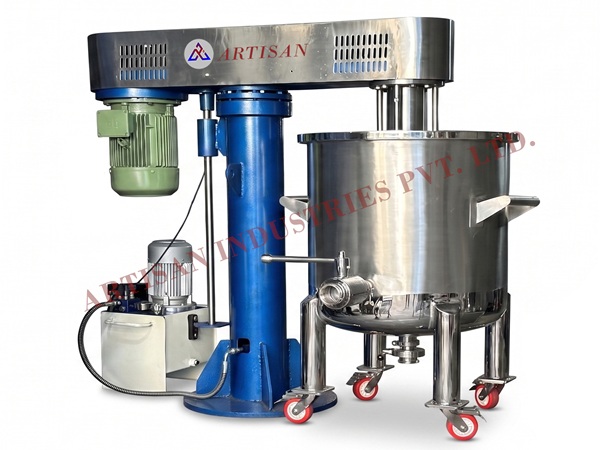
An anchor agitator is a low-speed, industrial mixing blade designed specifically for handling highly viscous (thick and sticky) fluids. It gets its name from its distinctive shape, which mirrors the contour of the mixing vessel’s walls.
Unlike high-speed propellers that create aggressive whirlpools, an anchor agitator works by physically pushing a large volume of heavy material along the perimeter of a tank.
To maximize efficiency and eliminate the risk of product degradation, modern anchor agitators are frequently retrofitted with wall scrapers. Fabricated from resilient materials like PTFE (Teflon) or specialized elastomers, these flexible scrapers physically wipe the vessel’s interior surfaces during rotation. Wiping the walls prevents the formation of a stagnant, insulating film of product, which is a common point of failure when processing heat-sensitive materials like creams, structural adhesives, or starch solutions. While the primary flow pattern generated by a standard anchor is tangential—meaning the fluid rotates horizontally around the vessel axis—this can sometimes lead to localized swirling without sufficient vertical mixing. To counteract this limitation, engineers often incorporate vertical cross-members, angled baffles, or secondary high-speed disperser shafts within the anchor frame, creating a dual-shaft or multi-shaft mixing system that introduces axial fluid movement and high-shear capabilities.
Agitator Type
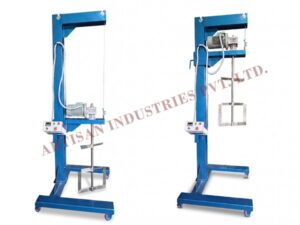
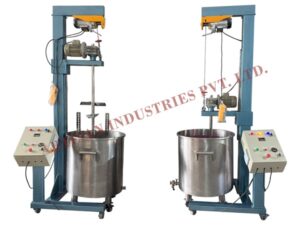
Why Choose the Artisan Anchor Design?
Our anchor agitator features a contour-matching profile that sweeps closely along the vessel wall. Operating at low speeds, it generates high shear near the tank surface. This specific motion prevents burning, caking, or localized overheating—making it the gold standard for heat-sensitive batches.
Whether you are processing thick polymers, heavy adhesives, cosmetics, or artisanal food batches, this impeller ensures steady, laminar flow throughout your mix.
Key Technical Performance:
- Contour-Matching Efficiency: Sweeps within millimeters of the vessel walls to eliminate dead zones and maximize thermal heat transfer.
- High-Viscosity Performance: Optimized for fluids ranging from 5,000 to over 100,000 cPs (centipoise), maintaining consistency where other mixers stall.
- Custom Fabricated Options: Available with optional PTFE wall scrapers to physically wipe the tank edges, ensuring 100% product recovery and easier clean-up.
- Premium Material Integrity: Constructed from heavy-duty 316L Stainless Steel or specialized alloys, polished to your precise hygienic requirements.